

See all papers
Europe's Next Generation of Entrepreneurs: Turning Business Succession into Business Renewal
Share this paper:


Download this paper:

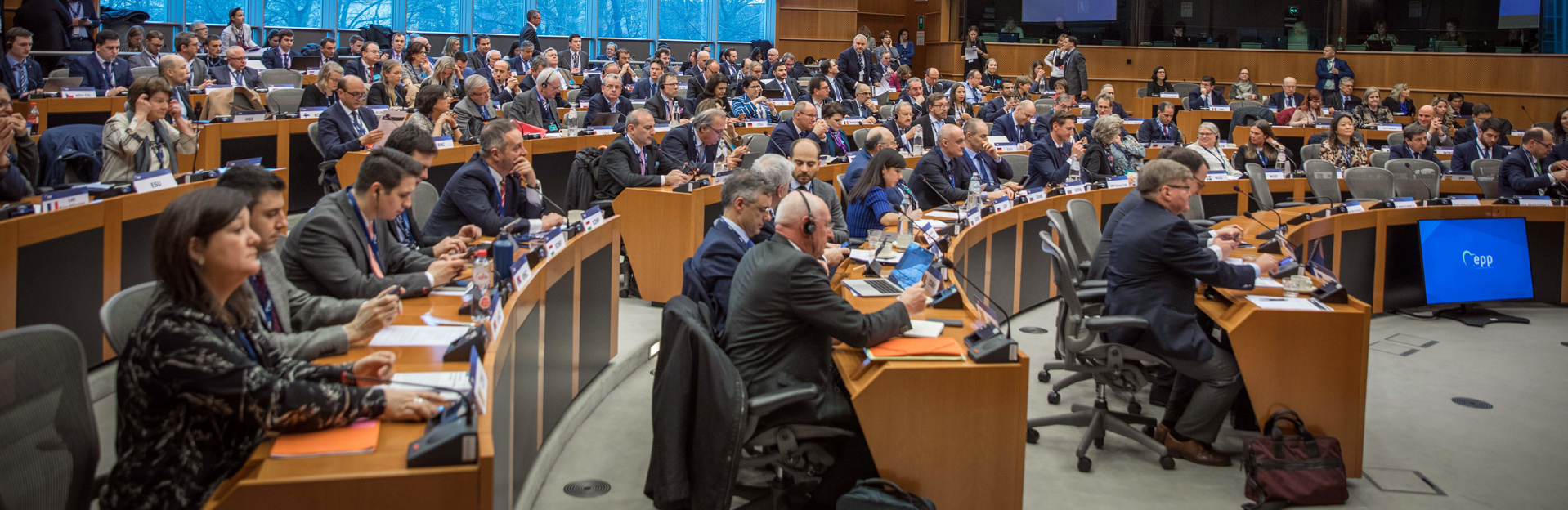
The European People's Party (EPP), meeting in its Political Assembly,
Reaffirming that SMEs, family businesses, crafts, the self-employed and liberal professions are the backbone of Europe's social market economy, sustaining jobs, skills, innovation and regional prosperity;
Recognising that taking over, modernising and growing a viable business is as entrepreneurial as founding one;
Concerned that demographic change and owner retirement are widening Europe's succession gap, putting viable companies, jobs, productive capacity, human capital, specialised knowledge and communities at risk;
Noting that almost 8.9 million self-employed people in the European Union were aged 55 or above in 2024, that the Commission estimates the number of companies potentially affected by a transfer to be in the millions over a ten-year period, that around 700 000 companies in France are expected to need a successor within ten years and that around 224 000 small business owners in Germany planned a transfer in 2023 and 2024 alone;
Welcoming Commission Recommendation C(2026) 3799 of 22 June 2026 as an important basis for action, while stressing that it must now lead to measurable implementation and a broader entrepreneurship policy;
Observing that acquiring an established and operating SME normally requires more capital than founding a new company, that access to finance is therefore a fundamental obstacle for capable successors, and that the difficulty of compensating co-heirs who do not wish to remain in the business is a recognized cause of otherwise avoidable closures;
Noting that women remain underrepresented among business owners and that better preparation and support for potential female successors can widen Europe's successor pool and unlock entrepreneurial talent;
Underlining that succession decisions must remain with owners and families and be based on competence, commitment and entrepreneurial responsibility, while public policy should widen opportunity and preparation rather than prescribe outcomes;
Insisting that action must respect subsidiarity, private property, freedom of contract, competition, and safeguards against fraud and abuse, without creating new SME reporting burdens;
Stressing that Europe must move from business continuity to business renewal, since a transfer is not merely the end of one entrepreneur's activity but a new entrepreneurial beginning; underlining that European policy must therefore cover the full business lifecycle of starting, growing, transferring and renewing a business;
The European People's Party:
Calls on the EU institutions to translate Commission Recommendation C(2026) 3799 into a coordinated European Business Renewal Agenda covering awareness, preparation, finance, legal frameworks, digital procedures and cross-border transfers; stresses that this agenda should build on existing structures wherever possible.
Calls for European and national policy to apply a 'transfer as entrepreneurship' principle, under which programmes supporting entrepreneurship, skills, innovation, internationalisation or business development do not exclude a capable person merely for taking over a viable company rather than founding a new one.
Recalls that, under the current rules, family members who have taken over, or plan to take over, a family business may already qualify for Erasmus for Young Entrepreneurs; calls on the Commission to pilot a clearly identified Business Succession Track within the existing framework in order to make this route visible and effective; stresses that no new programme is needed.
Stresses that the track should provide targeted outreach, successor-specific matching, exchanges with entrepreneurs who have completed a transfer, and mentoring on governance, finance and transition; underlines that it should support cross-border learning, business modernisation and outreach to potential female successors; calls for participation and outcomes to be monitored separately so that the track is developed on the basis of evidence and demonstrable added value.
Emphasises that Europe cannot afford to overlook qualified future entrepreneurs; encourages families, advisers and business organisations to consider the full pool of potential successors, on the basis of ability, commitment and entrepreneurial ambition; underlines that women should also have a genuine opportunity to acquire businesses outside their own families.
Underlines that women's entrepreneurship is one of Europe's most underused economic assets, and that a continent losing viable companies for want of successors cannot afford to draw on only part of its entrepreneurial talent; calls for existing women's entrepreneurship programmes to cover business acquisition and succession alongside start-up creation, and stresses that a transfer should be financed on the strength of the business case, not on the personal circumstances of the buyer;
Calls on the EIB Group, InvestEU, national promotional banks and private institutions to adapt guarantees, loans, equity and patient capital to viable SME transfers, covering both the acquisition and the investment needed to modernise and grow after transfer, with public financing targeted at identified market failures and designed to leverage, rather than crowd out, private capital.
Underlines that particular attention should be paid to microenterprises, rural businesses, crafts and cases in which co-heirs must be compensated without weakening the operating company; stresses that a lack of appropriate finance should not make closure, fragmentation or a forced sale the only options for an otherwise viable SME.
Calls on the Member States to strengthen trusted mechanisms connecting sellers and successors while protecting confidentiality, personal data and business secrets; calls on the European Union to support interoperability between credible national and regional platforms and cross-border referral networks, rather than create a new centralised bureaucracy.
Stresses that the Single Digital Gateway, the once-only principle and, once operational, European Business Wallets should reduce duplicate documentation and enable the secure exchange of verified company information.
Underlines that entrepreneurs should have clear, multilingual guidance on the legal, tax, employment and financing implications of cross-border transfers; calls on national authorities and business organisations to help viable companies identify qualified successors beyond their domestic markets.
Encourages the Member States, within their national competences, to consider targeted tax incentives so that transferring a viable business is not the most expensive option available to an owner; notes that exemption, reduction or deferral of inheritance, gift and capital-gains taxation, and lower stamp duties and registration fees, can be decisive for whether a company continues to operate or is broken up.
Underlines that any relief must be targeted, transparent, compatible with State aid rules and protected by effective anti-abuse safeguards; stresses that its purpose is continued operation, investment and development, not passive tax advantage.
Recalls that Europe does not have to choose between start-ups and established companies, or between innovation and continuity; underlines that a competitive and resilient Europe enables people to start businesses and enables viable businesses to pass to a new generation of entrepreneurs.
Resolves to make business renewal a central pillar of its entrepreneurship, competitiveness and Single Market policy; underlines that the objective is clear: no viable European business should disappear for lack of a next entrepreneur, and no capable next entrepreneur should be overlooked.
Read more
Share:

Manifesto 2024
The EPP Manifesto outlines the basic principles of the Party summary.
The EPP Manifesto outlines the basic principles of the Party summarising who we are, what our values are, what challenges are we facing and what vision we have for the future. The Manifesto was developed in parallel to the EPP Platform document within the EPP Working Group 1 for “European Policy”.
Download:

Platform
The EPP Platform is the core programme of our party outlining our main values, explaining the challenges our society is facing and presenting our vision for the future of European Union.
The EPP Platform is the core programme of our party outlining our main values, explaining the challenges our society is facing and presenting our vision for the future of European Union.
The Party Platform was developed in EPP Working Group 1 for “European Policy” chaired by EPP President Wilfried MARTENS ?and EPP Vice President Peter HINTZE. The Working Group consists of delegates of EPP member parties who prepared and worked?on this document for more than two years and received input?from the drafting committee as well as senior and young experts. The document was adopted at the 2012 EPP Congress in Bucharest, thus replacing the Basic Programme of Athens from 1992.