

See all papers
Interference of Political Islam in European democratic processes
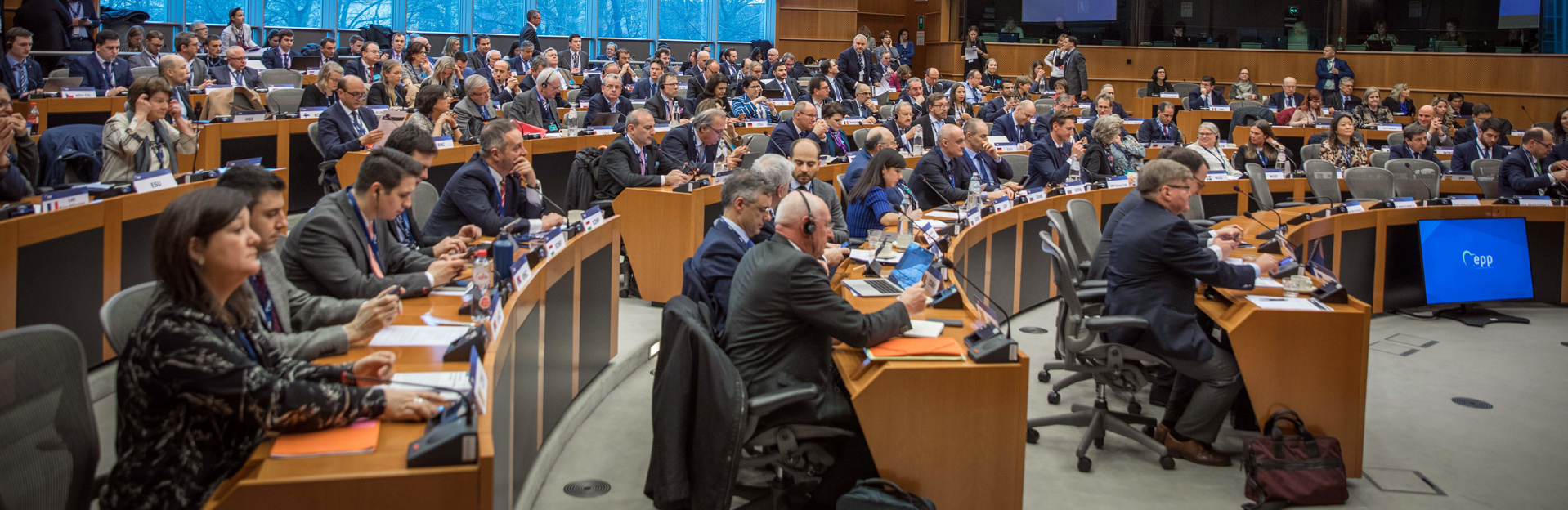
Resolution adopted by the EPP Political Assembly of 29-30 June 2026
Share this paper:


Download this paper:

As the European People’s Party (EPP), we are deeply committed to striving for a European society that is united in its diversity, respectful of everyone’s beliefs, and protective of individual freedoms. To defend this vision, a fundamental effort must be made to identify the ideological, relational and institutional forms of interference that could undermine democratic processes and promote an illiberal agenda undermining those individual freedoms.
In that framework, we are concerned with Islamist entryism as a structured political strategy that promotes an ideological project in which the religious, the social, the legal and the political are conceived as inseparable. This dogmatic interpretation of a religion, meant to guide not only private life but also public policy and political order, is pushed under the form of entryism, or infiltration, in an insidious way, to the detriment of Muslim communities who practise their faith in harmony with democratic principles.
Addressing the matter is not intended to be a discriminatory enterprise, but a way to safeguard democratic systems and individual freedoms. We therefore address this issue in a pragmatic way, drawing a clear distinction between political Islam as an ideology and the Islamic faith.
Similarly to other foreign and third-party interference extensively analysed by European policymakers (such as Russian and Chinese meddling in democratic procedures), we recognise the politico-religious interference in European democratic processes as an external and undue involvement in democratic processes.
As EPP, we see entryism as a strategy of gradual infiltration of institutions, parties, associations, and administrations to push for a fundamentalist interpretation of a religion, meant to shape the public and political life according to a rigorist vision. Entryism manipulates the democratic concepts by adopting a double discourse, to appear compatible with commonly accepted democratic principles, while its actual agenda runs counter to those values in many ways. We consider Muslim Brotherhood as a relevant example of this strategy, as well as its affiliated associations.
We stress that entryism highly differs from the legitimate expression of political convictions coming from religious communities. We are firmly attached to the unity of European people, their cohesion and their personal freedom, namely their freedom of conscience and religion. We firmly believe those principles will be safeguarded by upholding individual rights, ensuring equality among citizens, rather than collective claims.
We recognise that the particular nature of entryism challenges our democracies to find the right solutions to combat it, thereby ensuring both the peaceful practice of every religion and the integrity of our democratic processes.
To identify those radicalised movements, we stress the importance of mapping Islamist organisations networks, training elected officials and administrations, protecting independent research, and improving due-diligence mechanisms. Such monitoring mechanisms must pay particular attention to undesirable foreign funding, that could come from third countries promoting the same illiberal agenda.
We call for the termination of EU support for these radicalised movements. The European Commission should therefore enhance transparency in fund allocation, ensure that resources do not end up favouring extremist organisations promoting an illiberal agenda, exclude actors linked to Islamist movements from as well as terminate any partnerships the European Commission still has with such organisations.
We strongly support Member States’ cooperation to counter this phenomenon, namely through intelligence sharing, as well as online and offline countering of Islamist radicalisation. Cooperation is also essential to determine at European level an appropriate legal framework for identifying and effectively combating infiltration schemes, for example based on specific patterns of evidence, and for developing a common indicator framework for Islamist entryism, for example through Europol.
We believe that further academic research is paramount. The EU needs to increase its academic capacity on the concept of “Political Islam”, radicalisation and exploitation of religious beliefs, not only amongst academics and institutions, but also as a means of raising public awareness and developing prevention mechanisms to tackle the phenomenon’s roots and consequences. Safeguarding an environment where research is carried out independently and without intimidation is imperative.
The European Union could support training programmes for teachers, students, social workers and practitioners on the ground, aimed at identifying processes of radicalisation.
The phenomenon of Islamist entryism needs to be understood as a broader ecosystem operating simultaneously across various domains and spheres. As the most influential political party in the EU, we call for a pragmatic approach to the topic, in close coordination with relevant partner-parties in Europe and other parts of the world, such as the MENA region and the Western Balkans.
Read more
Share:

Manifesto 2024
The EPP Manifesto outlines the basic principles of the Party summary.
The EPP Manifesto outlines the basic principles of the Party summarising who we are, what our values are, what challenges are we facing and what vision we have for the future. The Manifesto was developed in parallel to the EPP Platform document within the EPP Working Group 1 for “European Policy”.
Download:

Platform
The EPP Platform is the core programme of our party outlining our main values, explaining the challenges our society is facing and presenting our vision for the future of European Union.
The EPP Platform is the core programme of our party outlining our main values, explaining the challenges our society is facing and presenting our vision for the future of European Union.
The Party Platform was developed in EPP Working Group 1 for “European Policy” chaired by EPP President Wilfried MARTENS ?and EPP Vice President Peter HINTZE. The Working Group consists of delegates of EPP member parties who prepared and worked?on this document for more than two years and received input?from the drafting committee as well as senior and young experts. The document was adopted at the 2012 EPP Congress in Bucharest, thus replacing the Basic Programme of Athens from 1992.