

See all papers
Ukraine’s European Future, Democratic Resilience and Political Pluralism
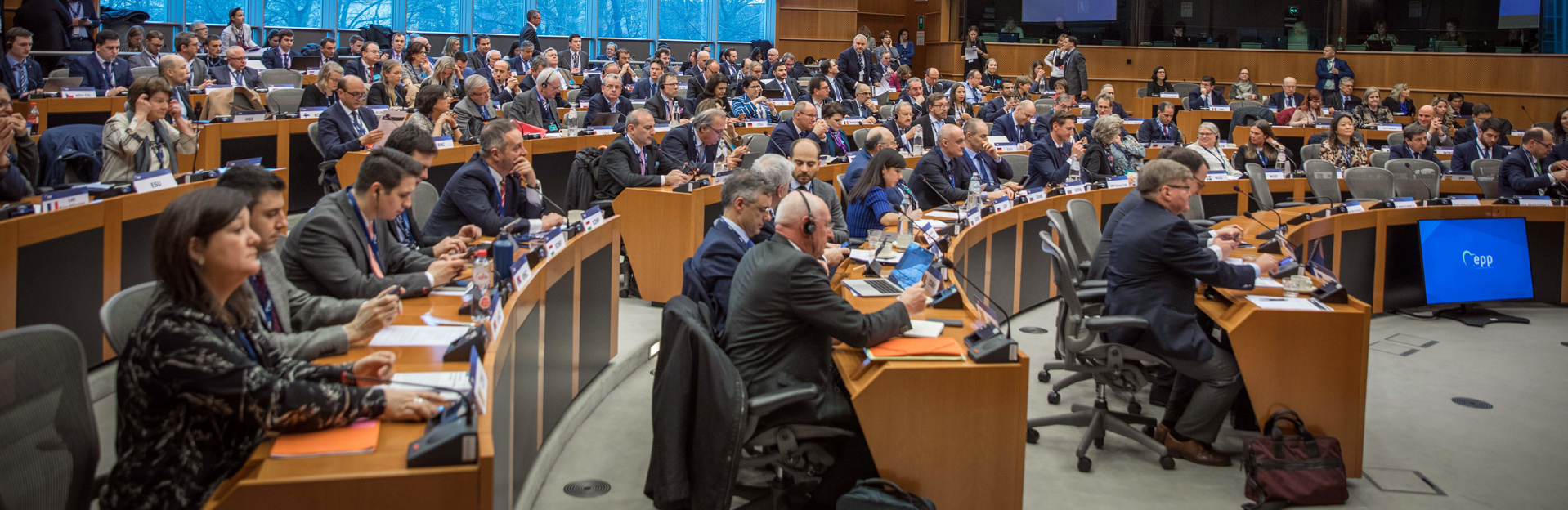
Resolution adopted by the EPP Political Assembly of 29-30 June 2026
Share this paper:


Download this paper:

Condemning in the strongest possible terms Russia’s ongoing illegal, unprovoked and unjustified war of aggression against Ukraine, including its devastating bombardments of Ukrainian cities, critical infrastructure, civilian buildings and objects of cultural heritage, notably the barbaric attack on the Kyiv-Pechersk Lavra, which have resulted in widespread destruction and mass civilian casualties;
Recognising the sacrifices of the Ukrainian people in defence of freedom, democracy and European values ;
Reaffirming our unwavering solidarity with the Ukrainian people and steadfast support for Ukraine’s independence, sovereignty and territorial integrity within its internationally recognised borders;
Stressing that any credible peace process on the side of Russia must be preceded by an immediate, comprehensive and unconditional ceasefire;
Reaffirming that a just and lasting peace cannot be achieved at the expense of Ukraine’s sovereignty, territorial integrity or right to determine its own future;
Underlining that continued military, economic, financial and political support for Ukraine remains essential to maintaining strong negotiating positions and ensuring a sustainable peace settlement;
Recognising the need for more active engagement of the European Union in the peace process as the negotiated solutions will determine the security of not only Ukraine, but the whole European continent; in this regard, calling on the European Union to appoint a high-level representative of the European Union for peace negotiations;
Calling on the European Union and its Member States to adopt a comprehensive, long-term and strategic approach to supporting Ukraine, moving beyond ad hoc assistance measures; stressing the need for a structured European strategy combining sustained political, military, economic, financial and industrial support; underlining the crucial role of providing the security guarantees to Ukraine in post-war period with EU accession being the solid basis for such commitments.
Calling for a substantial increase in EU defence production capacities and for stronger coordination of procurement mechanisms across Europe in order to ensure timely delivery of ammunition, air-defence systems and other critical military equipment to Ukraine;
The European People’s Party:
Welcomes efforts aimed at bringing Ukraine closer to the European Union and the decision of the Council of the EU on 15 June 2026 to open the first negotiation cluster “Fundamentals” in Ukraine’s accession process to the European Union; and looks forward to opening all the remaining clusters without unnecessary delay.
Reaffirms that the EU enlargement process shall remain inclusive, individual, merit-based and firmly anchored to the Copenhagen criteria and the established enlargement framework; stresses that innovative approaches should be explored to accelerate the practical integration of candidate countries, particularly Ukraine, into European policies, programmes and institutions wherever possible; calls for concrete steps to implement the reform of the EU, which is required to better prepare for the next enlargement waves.
Recognises the significant progress achieved in implementation of the EU-Ukraine Association Agreement, including establishment of a deep and comprehensive free trade area, which advanced the process of gradual integration of Ukraine into the EU.
Welcomes the adoption of the EU–Ukraine reform agenda agreed in December 2025, including the reform priorities aimed at strengthening the rule of law, judicial independence and anti-corruption institutions; encourages the Ukrainian authorities to accelerate implementation on the basis of clear benchmarks, measurable results and sustained political commitment; stresses that timely and effective reforms remain essential for strengthening Ukraine’s democratic resilience, public trust and the speed of EU accession process.
Calls on the Ukrainian authorities to continue addressing outstanding challenges in the field of judicial reform, particularly with regard to judicial independence, accountability and public confidence in the judiciary; further encourages continued efforts to reform the Security Service of Ukraine (SBU), the State Bureau of Investigation (SBI) and the State Financial Monitoring Service in line with European standards.
Recognises the work of Ukraine’s specialised anti-corruption institutions in investigating and prosecuting high-level corruption cases.
Stresses that ensuring the effectiveness of the National Anti-Corruption Bureau of Ukraine (NABU) and the Specialised Anti-Corruption Prosecutor’s Office (SAPO) remains a key prerequisite for the rule of law and Ukraine’s EU accession process; reiterates the importance of safeguarding their institutional and operational independence; condemns any form of political interference.
Emphasises that the institutional and operational independence of anti-corruption agencies should go hand in hand with transparency and accountability.
Welcomes Ukraine’s continued efforts to preserve democratic governance under the extraordinary conditions of war; stresses the importance of safeguarding democratic institutions, the separation of powers, parliamentary oversight and political pluralism, local self-government, the rule of law and respect for fundamental rights and freedoms as key elements of Ukraine’s resilience; calls on all political stakeholders in Ukraine to strengthen institutional cooperation and inclusive decision-making in the national interest, particularly in the context of Russia’s ongoing war of aggression and Ukraine’s EU accession process.
Recalls that the protection of national minorities constitutes a core element of the Copenhagen criteria and fundamental condition of the EU accession process; welcomes the commitments undertaken by Ukraine within the framework of the EU-Ukraine Accession Action Plan, calls on the Ukrainian authorities to implement these commitments without further delay.
Underscores the need to vigorously pursue decentralization reform to strengthen the role of the bodies of local self-government.
Reiterates its concern regarding restrictions on mandate-related foreign travel for Members of the Verkhovna Rada and recalls the important role of parliamentary diplomacy in sustaining international support for Ukraine; calls for a review of any unnecessary restrictions that limit the ability of elected representatives to engage with international partners in the performance of their duties.
Urges the Ukrainian authorities to refrain from politically motivated judicial proceedings, selective prosecution or disproportionate restrictions, illegal personal sanctions directed against opposition leaders and representatives of civil society or independent media and to ensure that criminal justice mechanisms are never used, or perceived to be used, as instruments of political pressure against the democratic opposition.
Calls upon all public authorities to fully respect the presumption of innocence and avoid statements that may prejudge ongoing legal proceedings.
Recalls that, in the context of Ukraine’s EU accession process, the effective protection of the right to a fair trial requires that all judicial proceedings be conducted in full compliance with the European Convention on Human Rights and the jurisprudence of the European Court of Human Rights; stresses in particular the need to ensure proceedings without undue delays and to uphold judicial independence, legal certainty and equality before the law.
Underlines that internal political unity is a strategic asset for Ukraine; calls for the strengthening of internal political unity through dialogue, inclusion and constructive, meaningful and non-discriminatory cooperation among all parliamentary political forces represented in the Verkhovna Rada; underlines the importance of safeguarding multi-party democracy, parliamentary pluralism and media pluralism as essential elements of Ukraine’s democratic development and European future.
Read more
Share:

Manifesto 2024
The EPP Manifesto outlines the basic principles of the Party summary.
The EPP Manifesto outlines the basic principles of the Party summarising who we are, what our values are, what challenges are we facing and what vision we have for the future. The Manifesto was developed in parallel to the EPP Platform document within the EPP Working Group 1 for “European Policy”.
Download:

Platform
The EPP Platform is the core programme of our party outlining our main values, explaining the challenges our society is facing and presenting our vision for the future of European Union.
The EPP Platform is the core programme of our party outlining our main values, explaining the challenges our society is facing and presenting our vision for the future of European Union.
The Party Platform was developed in EPP Working Group 1 for “European Policy” chaired by EPP President Wilfried MARTENS ?and EPP Vice President Peter HINTZE. The Working Group consists of delegates of EPP member parties who prepared and worked?on this document for more than two years and received input?from the drafting committee as well as senior and young experts. The document was adopted at the 2012 EPP Congress in Bucharest, thus replacing the Basic Programme of Athens from 1992.